mint.com and Experian – strange bedfellows

See if you can follow this.

The players

The Consumerist, a former property of notorious Gawker Media, is now owned by Consumers Union, publisher of Consumer Reports.  The move is nearly inexplicable, but, apparently, CU thinks that that is how to get young and hip.  But there is a firewall.  A new entity, Consumer Media LLC, houses The Consumerist.  The domain was registered by Consumers Union in December, 2008.  Requests for the home page of http://consumermediallc.org/ are redirected to consumerist.com.

Mint.com is owned by Intuit, the publisher of Quicken personal finance software.  Mint/Quicken is a Believer, saying, viral video-style:

These days, credit scores are not only used by lenders but by everyone from landlords to prospective employers.  A bad score can keep you from getting an apartment, a mobile phone or even a job. – Quicken, March 4, 2010

Now before you get sucked in by that bit about employers, see this video for another perspective.

Other minty-fresh advice includes: 

Make a large purchase using your credit card and pay it off immediately. This impressive payment behavior will earn you good marks. – Mint.com

The only guy likely to be impressed is the one you buy the big-screen TV from .  A history of a large balance is not part of the FICO score scheme.  And the only way to create a credit card history is to let a balance ride long enough to have a record.  Further, as everybody knows by now, high balances compared to limits kill.  But do enjoy your fabulous vacation.

Now, back to the story

Last week, the Consumerist gushed, “Mint.com has an exhaustive article about perfecting your credit to achieve the highest possible ‘elite’ score: anything over 800.”

Exhaustive?  Hardly.  More like exhausting.

According to Mint, the article (“Can You Increase Your Credit Score to 850”) is provided by Experian.com.

Experian.com in that sentence actually links to the disgraced FreeCreditReport.com owned by Experian. The national consumer reporting agency’s Web site was even parodied by its own regulator, the Federal Trade Commission. In the ultimate irony, the FreeCreditReport.com’s home page has to ask the question a consumer might wonder about a site with such a name: “Why isn’t my Credit Report free?” Oft-quoted credit report expert John Ulzheimer calls a recent FTC action the Experian Rule.

Mint.com addresses the concerns of its members:

We link to services provided by two of the largest credit bureaus (FreeCreditReport.com by Experian and TrueCredit by TransUnion) because banks and financial institutions check your credit profile with these bureaus. The services give you access to your credit score, credit report, and credit monitoring alerts.

Fake-O FICO Funk

However, the credit score at Experians’s FreeCreditReport.com is not sold to lenders. That score, the PLUS, is a Fake-O (a term acquired by a member of Congress in a hearing  last month).

Lots of people in social media dig the 850 score Mint article.  In its first paragraph, it mentions a consumer who thinks he is “a financial unicorn,” and explains that only 5.7% of Americans achieve an 800 (according to Credit Karma). The next paragraph refers to the consumer’s FICO score. However, FICO states that roughly one in 8 have a score of 800 or more.  Further, myFICO.com illustrates the 800 club with the figure 13%, not 5.7.

And then, there’s this in the Mint piece:  “Since debt utilization makes up 30 percent of your credit score – the second biggest factor after timely payments – carrying a balance can keep you out of the credit-elite category.”

So, here’s the big question:  If debt utilization is 30%, then what percentage is “Number of accounts with balances“?  And, what percentage is the “Lack of a specific type of balance, in some cases”?

Finally, Mint.com suggests, “In general, the rules to join the credit elite are simple: make timely payments, keep your credit utilization up to about 25 to 35 percent of your available credit, and minimize credit inquiries.”  But, FICO disagrees. Su–ze — Or–man, whose face you can see– right– on– myFICO.com, writes, “The FICO brain trust says there is no specific number that qualifies as a ‘good’ ratio, just that lower is always better.” And, FICO spokesman Barry Paperno said, flat out, “The lower that utilization number is, the better it is for your score.” The scrap heap of comments in that regard just got a little bigger.

Impossible

But, by far, the worst thing about the Mint credit score article is that its “provider,” Experian, can’t even come to an arrangement with FICO to allow consumers to see their FICO score like the other two national consumer reporting agencies.  And the scale of the PLUS score, the score to which the article links through FreeCreditReport.com, ends at 830, not 850 as in the title. In other words, you could do everything right– make all your payments on time, pay down your credit cards, have the optimum number of accounts– and pay the admission to check your score regularly and religiously for years.  But you would never get to 850 because that number doesn’t exist in the PLUS score range.

If the notion behind Consumers Union is buyer beware, reader beware of Consumers Union.  One thing is for sure:  Whenever Experian or Consumers Union is involved, nonsense is sure to follow.

Legislation uses FICO, not Fake-O, score as benchmark

H. R. 600, the FHA Seller-Financed Downpayment Reform Act of 2009, introduced by “Mr. AL GREEN of Texas (for himself, Ms. WATERS, and Mr. GARY G. MILLER of California)” uses the term “FICO score” 5 times.  It is a bill “To revise the requirements for seller-financed downpayments for mortgages for single-family housing insured by the Secretary of Housing and Urban Development under title II of the National Housing Act.”  

In March, 2010, Representative Green said, “Thank you very much, and thank for that new term for my vocabulary: Fake-O.” (2:13:58 in the video)

credit score, employers, Center for Responsible Lending

From: Greg Fisher 
Sent: Tuesday, March 30, 2010 10:51 AM
To: julia.gordon@responsiblending.org
cc: drshow@wamu.org
Subject: credit score, employers, Center for Responsible Lending

In response to Diane Rehm’s question about credit score use in pre-employment screening, you did not disagree with the premise:  Employers use credit scores.

What evidence suggests that employers use credit scores?

What is the name of an employer who uses credit scores?

(:47:07)

DIANE REHM:  We have heard from various callers and e-mailers that if you walk away from your home– if your credit score is bad-bad-bad– that your next potential employer may look at that score– may look at that record– and that that record could be held against you.  Julia?

JULIA GORDON:  More and more employers are doing credit checks before they hire somebody.  So, ruining your credit score can have all sorts of anticipated and unanticipated consequences, which is why, again, I would really encourage people:  If your credit is good, and you have the opportunity not to become delinquent on a loan, please don’t.

employers and credit scores, Kirwan Institute

From: Greg Fisher
Sent: Monday, March 29, 2010 1:41 PM
To: Jessica Leveen Farr
Subject: credit score, employers, Kirwan Institute

Recently, you wrote, “Landlords may evaluate an individual’s credit prior to renting a home and some employers access credit scores for all new hires.” 

Your footnote cites the document, “The Impacts of Foreclosures on Families and Communities: A Primer,” by G. Thomas Kingsley, Robin E. Smith, and David Price. 

The only mention of credit scores in that document is in an endnote, referring to the document, “Credit Scores, Reports, and Getting Ahead in America,” by Matt Fellowes.

That document refers to a survey:  “A 2004 survey of companies by the Society for Human Resource Management, for instance, found that 35 percent of companies used credit reports for this purpose, up from 19 percent in 1996.”

In April, regarding its 2004 “Reference and Background Checking Survey,” the SHRM replied, “Neither survey discusses credit scores, only credit checks.”

What indicates that employers use credit scores?

What is the name of an employer who uses credit scores?


From: Hughes, Jennifer [SHRM]
Sent: Thursday, April 09, 2009 5:04 PM
To: creditscoring.com
Subject: RE: credit score, employers III

Hi Greg,

Neither survey discusses credit scores, only credit checks.

[full correspondence with SHRM]

Kucinich, DFAS, ABC, employers and credit scores

According to the web site of Congressman Dennis Kucinich (D-OH), employees at a federal agency have been suspended due to low credit scores.

kucinich20101
Rep. Dennis Kucinich

A press release on kucinich.house.gov states, “The bipartisan group requested a suspension of a policy that has resulted in the unjust suspension of employees for reasons such as a low personal credit score until a full review can be conducted.”

The sub-headline is “Employees Suspended Indefinitely for Reasons such as Low Credit Scores.”

The release refers to a letter to the director of the Defense Finance and Accounting Service (DFAS) that was signed by Kucinich and three other Ohio members of the House of Representatives.  The letter uses the term “credit rating,” but does not contain the word score.

Consumer reporting agencies Equifax, TransUnion and Experian all state that they do not provide credit scores for employment screening.  A day before the Representatives’ letter, TransUnion submitted written testimony to the House Financial Services Committee stating: “We believe it is worth noting that credit scores are not used in connection with employment. TransUnion will not provide any score on a credit report that is obtained for employment purposes.”

A. Troy Marshall is the president of the American Federation of Government Employees (AFGE) – Local 3283.  Representative Marcia L. Fudge is a member of the House of Representatives from Ohio’s 11th district.  ABC news reports, “Marshall, however, argues that DFAS is making decisions based simply on the credit score” and “Like Fudge, Marshall says he’s not opposed to credit checks in principal, but says he believes the government should take an employees‘ performance and work history into account instead of relying just on a credit score.”

The Defense Office of Hearings and Appeals reviews cases regarding employees, contractors, security clearances and debts using the “whole-person analysis.”

Credit Karma suggests having creditors lie to credit bureaus


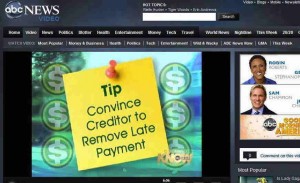
Credit Karma suggests groveling

Credit Karma CEO Ken Lin says that if you don’t like your credit history, just make one up.

Yesterday, the ABC News NOW interview subject said to beg your lender to change its report to the consumer reporting agencies about you to something more positive.  Lin thinks pestering the bank helps, too.  “You might want to try multiple times if you don’t get a good result the first time,” he said.

Anchor Tanya Rivero plays right along as Lin says, “It’s been known to happen where you can get a lender to remove a delinquency particularly if you were traveling or some other occurence happens.” 

Lin’s malarkey about lying is known elswhere as the Goodwill Adjustment, and is a fashionable notion in pop media circles.

(This vidcap that makes him look like a bozo is a coincidence.)

Employers, scores and WBIR 10 News at Five

WBIR TV-10, Knoxville asks, “Did you know that many potential employers check your credit score?”

And, the people at the East Tennessee Gannett television station want you to tell them what you think.  Their website says, “Selected comments will air on Wednesday’s 10 News at Five.” 

Here is one comment that may or may not make it on the air:

GregFisher wrote:

Consumer reporting agency Equifax stated, “We do not knowingly provide scores for pre employment screening.”

Experian stated, “Experian’s business policy prevents the inclusion of credit scores with an employment report, at Experian called Employment Insight.”

And, in Oregon, a TransUnion official testified, “There’s no such thing as a credit score in employment.”

http://tinyurl.com/ylqv76y

Who is your source regarding credit score use by employers?


UPDATE, 3/3/2010, 10 pm

It didn’t make it.

What did make it was one that said, “A low credit score does not mean someone will not be a valuable or trustworthy employee.”

That’s another one to add to the video compilation.

Impossible zero credit score: Ulzheimer 1, Ramsey 0

Exploding Dave Ramsey’s Zero Credit Score Myth on Ramsey’s Home Turf

Following the Credit CARD Act becoming effective, Credit.com’s John Ulzheimer appeared on the FOX Business Network  (“the only business network in true high definition”) this morning in a segment called “Tips for Boosting Your Credit Score.”

Cross-promoting “financial expert” blowhard Dave Ramsey, anchor Brian Sullivan referred to his colleague saying, snarkily, “I am sure you are very familiar with a guy named Dave Ramsey, right?” (3:00)

On the other hand, his tone, dripping with sarcasm, could have been evidence of utter disdain for Ramsey’s schtick.

Unimpressed, Ulzheimer said: “I’m familiar with Dave.  Yes.” 

Sullivan repeats the mantra that Ramsey’s score is “famously zero” and qualifies it with “or low” (and fails to mention that it could be nonexistent).

The guest chuckles and says that that is incorrect because a person cannot have a score of zero because the scale is 300 to 850.

The host interrupted the guest when he made that point. Ulzheimer politely allowed him to speak, then finished the interview.

Let’s hope FBN has Ulzheimer back on the air even though he flogged the interviewer and the crazy zero claim.  Outside of the FICO company itself (and even that is questionable), nobody knows more about– and can better explain– credit scores.  Get his book if you don’t believe it.

So, what is so bad about Ramsey saying that his FICO credit score is zero?  Imagine a guy who hears that his score is 425 and thinks he’s halfway to 850 when, in reality, his score is in the lowest 2%.  Perhaps it is the fault of the FICO company with its arcane scale (instead of something logical like 0 to 1000), but it is what it is.

Mr. Ramsey, tell the truth.  What are your scores, really?


Into the Audience – Credit scores and employers, CNM

The internet:  A place where almost anybody can write almost any nonsense. 

Here’s a good example.  CNM News Network’s piece on credit scores states, “Currently, employers can pull a job applicant’s credit report, but don’t have access to the actual score.”

However, the title is “Foreclosures and Job Hunting Don’t Mix as Employers Check Credit Scores.”

Watch as the publisher reacts to a comment on its page:

Your article says that employers don’t have access to credit scores, but your title screams that employers check them.

What gives?  Who told you that employers check credit scores?

Greg Fisher

Continue reading Into the Audience – Credit scores and employers, CNM